Marcel Jean (1900- 1993)
.jpg)
Born in 1900 in La Charité-sur-Loire, Marcel Jean was a French artist and a member of the surrealist group formed in Paris around André Breton.
While living in New York in the early 1920s, this young graduate of the École des Arts Décoratifs de Paris kept abreast of avant-garde movements and subscribed to La Révolution Surréaliste. One can assume that few curious minds in New York received this publication at the time. His meeting with the group was anything but accidental; upon returning to Paris in 1932, Marcel Jean joined the AEAR (Association des Écrivains et Artistes Révolutionnaires) with the specific goal of meeting the surrealists, who had promised to populate its literary section. The endeavor was a success, and from the very first meetings at the café on Place Blanche, André Breton showed him great kindness and encouraged him to show his work.
His drawings from this period are superb inks, teeming with fantastical details and startling associations. These compositions are emblematic of surrealist research into the representation of the unconscious, dreams, memories, and omens.
Alongside this intense graphic activity, Marcel Jean explored and innovated. At the end of 1934, he had a decisive encounter with Oscar Dominguez. The boisterous Canarian became one of his closest friends. It was at Jean’s home that Dominguez perfected the technique of decalcomania. For Breton, this was a major discovery and the first experience of absolute automatism in painting. Surrealist friends (André Breton, Jacqueline Lamba, Yves Tanguy, Georges Hugnet) flocked to Marcel Jean’s studio to experiment with decalcomanias. However, only Jean and Dominguez pursued their experiments further, creating stencils with which they produced "premeditated interpretation decalcomanias," making lions (fig. Oscar Dominguez, Lion), windows, or gramophones appear within the patterns.
In May 1936, Marcel Jean gained significant attention at the surrealist exhibition of objects at the Galerie Ratton with his piece Spectre du Gardénia. This female bust with zippers for eyes was exhibited at MoMA that same year during the first institutional exhibition dedicated to Surrealism (before being permanently acquired by the museum in 1968).
After an exile in Hungary from 1938 to 1945, where he survived the terrible siege of Budapest, Marcel Jean returned to Paris and rejoined the survivors of the surrealist group. He then turned toward writing and published essays on the sources and writings of Surrealism. In 1959, The History of Surrealist Painting was published. This landmark work in the study of the movement established him as a historian and theorist of the group. Although he remained very active—constantly painting, engraving, and drawing—his visual work also began to reflect a retrospective vision of his career. Jean amused himself by redrawing over academic works from his youth, creating Picabia-esque transparencies. He continued to seek new automatic processes, such as "flottage," presented in 1956, which "consists of 'floating' oil colors diluted in turpentine on water and capturing the resulting traces and shapes on canvas or paper."
In 1975, he published Profil de Mémoire, a luxurious box set bringing together 36 old engravings and etchings (1935–1942). These engravings, sublimely incised and highly inventive, reveal the pleasure he took in the craft. As the century drew to a close, almost all the figures of the original Surrealist movement had disappeared. The time for tributes had come for Jean, who created medals for the Monnaie de Paris featuring the likenesses of Arp, Duchamp, and Dominguez. In 1990, he published Grisou, an album of decalcomania-stencils created with Dominguez in the 1930s—a project interrupted in 1936 by the Spanish Civil War—finally fulfilling the destiny of this major surrealist invention.
Thus, Marcel Jean, painter of dreams and memory, became their guardian, ensuring the posterity of the movement to which he remained faithful despite his break with Breton and the successive deaths of its protagonists. After spending the second half of his career revealing the footprints of his friends, Marcel Jean seems to have carefully hidden his own, within the depths of a rocky landscape or in the hair of a faceless profile.
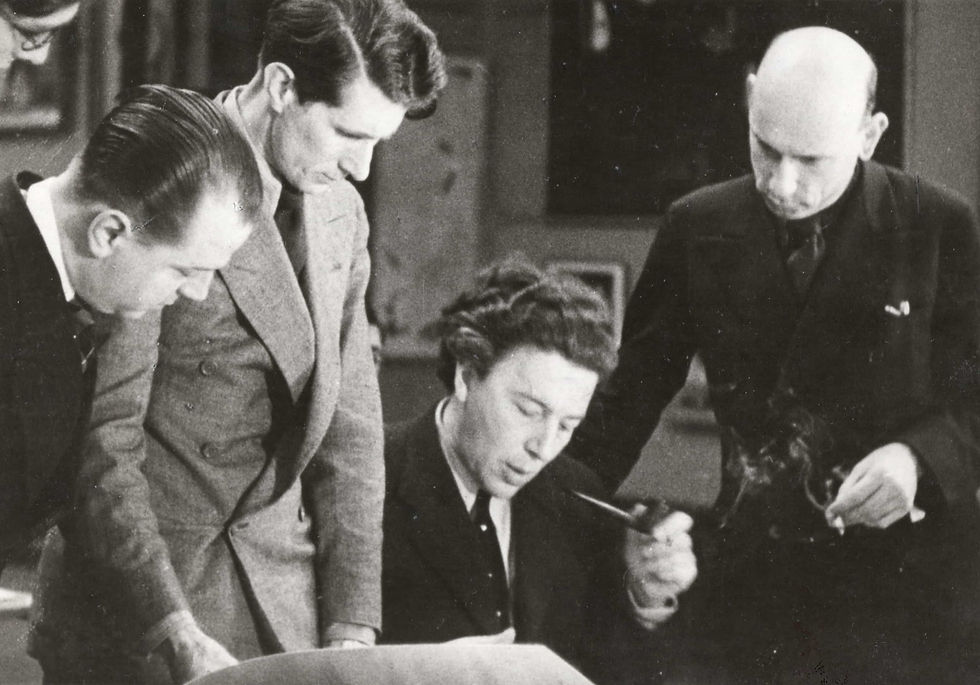
(left to right) E.L.T. Mesens, Roland Penrose, André Breton and Marcel Jean, at the International Surrealist Exhibition, London, 1936, courtesy Succession Marcel Jean
Artworks


Marcel Jean, les traces de pas, Galerie Boquet
Publications
Marcel Jean. Les traces de pas
Booklet published on the occasion of the exhibition Marcel Jean. Les traces de pas, organized at the Galerie Boquet.
Texts by Jules Boquet.
ed. Galerie Boquet, 2025
_edited.jpg)