Dora Maar (1907- 1997)

Dora Maar, unknown photographer. Courtesy Archives Dora Maar
Dora Maar is primarily remembered as the face so often painted and drawn by Picasso in his haunting Weeping Woman portraits—so much so that her own fundamental place in 20th-century art history is frequently overlooked. Born Henriette Théodora Markovitch to a Croatian father and raised in Buenos Aires, she began her career as a photographer after studying at the Union des Arts Décoratifs. She soon reinvented herself as Dora Maar, a successful fashion and advertising photographer, before quickly transitioning into art photography, earning the acclaim of Man Ray and becoming a close associate of Brassaï.
Her talent propelled her to the heart of the 1930s avant-garde; she was a member of the Octobre group and a confidante of André Breton and his wife, Jacqueline Lamba. Her photomontages, which captured the "uncanny" (l'inquiétante étrangeté) of everyday life, were deeply rooted in the Surrealist poetic movement. Thus, she was already a central artist and figure within the Surrealist circle when she met Picasso in 1936. The two lovers became mutual inspirations: Maar encouraged Picasso during the creation of Guernica, documenting its every stage. She introduced him to the darkroom to create photograms together, while he urged her to return to drawing and painting. Initially influenced by Picasso’s stylization and subject matter, Maar’s painting gradually evolved toward a more meditative aesthetic. However, the war years were painful, and her relationship with Picasso deteriorated under the confinement of the Occupation. Their separation in 1946 led to a severe nervous breakdown, for which she was treated by Jacques Lacan.
This marked the beginning of a new, more private—even reclusive—life for Maar. She saw only a few friends and spent increasing amounts of time at her home in Ménerbes, in the Luberon region. Her work underwent a radical transformation; she painted Southern landscapes that leaned toward abstraction, utilizing techniques such as frottage and decalcomania, while largely abandoning photography. Having withdrawn from the art world and its commercial spheres, few knew what had become of the great Surrealist photographer. It was not until the sale of her studio and collection in 1998, a year after her death, that the true scale of her vast and diverse body of work was finally revealed.

(left to right) Adrienne Fidelin, Marie and Paul Cuttoli ; Man Ray, Picasso, Dora Maar
Works


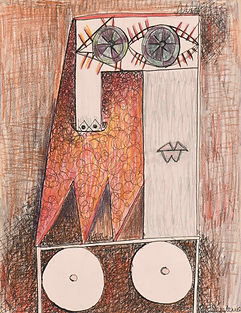


Ensemble of works by Dora Maar, The Muses. Inspiring and challenging Picasso, Artipelag, Stockholm, 2025.
Photo : Jean-Baptiste Béranger, courtesy of Artipelag
Publications
Celles qui avancent
Booklet published on the occasion of the exhibition Jacqueline Lamba, Dora Maar, Celles qui avancent, organized at the Galerie Pauline Pavec and the Galerie Boquet.
Texts by Victoria Combalia and Alba Romano Pace.
ed. Galerie Pauline Pavec and Galerie Boquet, 2024

Dora Maar. Secrets d'atelier
Catalogue published on the occasion of the exhibition at the maison Dora Maar in Ménerbes.
Texts by Patrice Allain, Brigitte Benkemoun, Gwen Strauss, Ambroise Audoin-Rouzeau. Interview between Brigitte Benkemoun and ORLAN.
ed. Dilecta, 2023
